Skip to content

DP5X


The DP5-X is a high performance digital pulse processor and power supply module, designed specifically for OEMs using Amptek’s SiPIN, SDD, and FAST SDD® detectors. It is a board level component which includes the key functions previously found in the DP5 and PC5 but at much smaller size and lower cost. It is designed to interface with Amptek’s PA210 and PA230 preamplifiers. It includes all power supplies needed for the detector, requiring only DC power and a standard communication interface. It includes an “interconnect” for interfacing to customer-supplied boards.

The DP5-X is essentially a specialized version of the DP5 and PC5, for OEMs using Amptek’s SiPIN, SDD, and FAST SDD® detectors. It does not replace the DP5 and PC5; these boards remain available for customers using Amptek’s CdTe detectors, other types of detectors (HPGe, SiPMT), other preamps, and for customers needing advanced features. The DP5 is the more flexible and general purpose processor. Amptek designed the complete system (DP5-X and new PA210/230 configurations) to provide the best possible performance/price point for OEMs.

Features

  • 80 MHz ADC
  • Replaces both shaping amplifier and MCA
  • Supports ONLY PA230 reset style preamplifiers for SiPIN, SDD, and FAST SDD.  
  • MCS Mode
  • 16 SCA’s
  • List Mode
  • Streaming Mode
  • For OEM or custom laboratory use
  • Highly configurable


Figure 2. Trace 1 above shows the input to the DP5X, which is the output from a reset-type charge sensitive preamplifier. This is processed by the analog prefilter producing the prefilter output shown in Trace 2. This is digitized and then processed digitally, producing the DP5X’s shaped output shown in Trace 3. Finally, the DP5X creates a multichannel anlayzer (MCA) type output spectrum shown in Graph 4.

Contact us for more information today!

  • Quick Reference +


    Features

    • 80 MHz ADC
    • Replaces both shaping amplifier and MCA
    • Supports both reset and feedback preamplifiers of either polarity
    • MCS Mode
    • 16 SCA’s
    • List Mode
    • Streaming Mode
    • Configurable with a charge sensitive preamplifier for use with PMTs
    • For OEM or custom laboratory use
    • Highly configurable

    Pulse Processing & MCA

    • Trapezoidal shaping
    • Commandable peaking time from 0.05 to 102.4 µs
    • Commandable flat top duration from 0.05 to 51.2 µs
    • 4,000,000 cps periodic
    • Pile-up rejection, risetime discrimination, gate
    • Up to 8k output MCA channels

    Communications

    • Interfaces: USB and optional RS232
    • Oscilloscope mode – DAC output for pulse monitoring and adjustment
    • Onboard µcontroller with 8051-compatible core
    • Many configurable auxiliary inputs & outputs available

    Software

    • Free Display and Acquisition Software
    • Free Software Developer’s Kit (SDK)

    Physical

    • Low Power: 1W typical
    • Small Size: 2.5 in X 1.5 in (63.5 cm x 38.1 cm)
    • M variant - 2.36 in  x 1.25 in;  32cm x  60cm

    Applications

    • X-ray and gamma ray detectors
    • Nuclear Instrumentation
    • Portable, battery operated systems
    • OEM & Special Applications
    • Process Control
    • Research and Teaching
  • Specifications +


    Specifications

    Pulse Processing Performance

    Gain Combination of coarse and fine gains yields overall gain continuously adjustable from x2.4 to x156.6.
    Coarse Gain 6 spaced coarse gain settings from x4.008 to x111.896
    4.008
    8.016
    13.987
    27.974
    55.948
    111.896

    Fine Gain Fine gain is adjustable between 0.60 and 1.4
    Full Scale 1000 mV input pulse @ x1 gain
    Gain Stability <20 ppm/° C (typical)
    ADC Clock Rate 20 or 80 MHz, 12 bit ADC (software selectable)
    Pulse Shape Trapezoidal. A semi-gaussian amplifier with shaping time t has a peaking time of 2.2t and is comparable in performance with the trapezoidal shape of the same peaking time.
    Peaking Times 26 software selectable peaking times between 0.05 and 25.6 µs @80MHz, and 24 software selectable peaking times between 0.8 and 104 µs @20MHz
    Flat Top Times 22 software selectable values for each peaking time (depends on the peaking time), >0.012 µs.
    Max Count Rate With a peaking time of 0.2 µs, a 4 MHz periodic signal can be acquired.
    Dead Time per pulse Dead time is 1.05 x peaking time. No conversion time.
    Fast Channel Peaking Times 20 MHz: 200, 400, 800, 1600, 3200 ns
    80 MHz: 50, 100, 200, 400, 800 ns
    Fast Channel Pulse Pair Resolving Time Equal to the fast channel peaking time plus the signal risetime.
    Pile-Up Reject Pulses separated by more than the fast channel resolving time, 120 ns, and less than 1.05 x peaking time are rejected.
    Baseline Restoration Assymetric, 32 software selectable slew rate settings.

    MCA Performance

    Number of channels Commandable to 256, 512, 1024, 2048, 4096, and 8192 channels.
    Bytes per channel 3 bytes (24 bits) – 16.7M counts
    Preset Acquisition Time 10 ms to 466 days
    Data Transfer Time 1k channels in 5 milliseconds (USB), 280 milliseconds (RS-232)
    Conversion Time None
    Presets Time, total counts, counts in an ROI, counts in a channel
    MCS Timebase 10 millisec/channel to 300 sec/channel
    External MCA Controls Gate input: Pulses accepted only when gated on by external logic. Input can be active high or active low.
    Counters Slow channel events accepted by MCA, Incoming counts (fast channel counts above threshold), event rejected by selection logic, and external event counter.

    Hardware

    Microprocessor Silicon Labs 8051F340 8051-compatible core
    External Memory 512kB low-power SRAM
    Firmware Signal processing is programmed via firmware, which can be upgraded in the field.

    Connections

    Flex Cable 10 wire flexible cable connector, Samtec ZF1-10-01-T-WT
    Power + 5 VDC. Hirose MQ172-3PA(55)
    RS-232 Standard 2.5 mm stereo audio jack. (optional)
    USB Standard USB mini-b jack.
    Auxiliary 2×15 30-pin .05" (12.7mm) spacing (Samtec part number CLP-115-02-G-D-A).

    Communications

    RS-232 Standard RS-232 serial interface at up to 115.2 Kbaud. (optional)
    USB Standard USB 2.0 full speed (12 Mbps).

    Auxiliary Inputs and Outputs

    The primary purpose of this connector is to bring out logic signals which are not required for the primary use of the DP5: acquiring spectra and transmitting them over the serial interface. These are generally “low level” logic signals associated with each pulse processed by the DP5. They are primarily used for synchronizing the DP5 data acquisition to external hardware and for direct counter/timer outputs from the DP5. The signals are described below. The connector is a 2×15 Samtec part number CLP-115-02-G-D-A, spacing 0.05" (1.27mm).

    Single Channel Analyzers (total of 16) Hardware
    8 SCAs with logic outputs, independent software selectable LLDs and ULDs, LVCMOS (3.3V) level (TTL compatible) The hardware SCA’s can also be directed to internal counters and read out by software.
    Software
    8 SCA’s, independent selectable LLDs and ULDs, selectable between 8 settings including INCOMING_COUNT, PILEUP, MCS_TIMEBASE, etc. The software SCA’s are connected to internal counters and read out by software.
    Digital Inputs Two independent inputs, software selectable for MCA_GATE, EXTERNAL_COUNTER I/O
    Two general purpose I/O lines for custom application.
    Digital Outputs Two independent outputs, software selectable between 8 settings including INCOMING_COUNT, PILEUP, MCS_TIMEBASE, etc.
    Two general purpose I/O lines for custom application.
    I/O Two general purpose I/O lines for custom applications.
    Digital Oscilloscope Displays oscilloscope traces on the computer. Software selectable to show shaped output, ADC input, etc., to assist in debugging or optimizing configurations.

    Auxiliary Connector Pin Assignments

    Pin #  Name  Use Pin #  Name  Use 
     DACOUT
    2 AUX1  
     C2D Test 4 AUX2  
    5  /RST/C2CK Test 6 AUX3  
    7 SDA I2C 8 AUX4  
    9 SCL I2C 10 TDP Ethernet 
    11 /RS232_INVAL   12 TDN  Ethernet 
    13  RX0 RS232  14 RDP Ethernet
    15  TX0 RS232  16 RDN Ethernet
    17  LED_GRN Ethernet  18 VBUS USB 
    19   LED_YEL Ethernet  20 USB- USB 
    21  SPARE   22 USB+ USB 
    23  GND   24 3.3V  External 3.3V 
    25  GND   26 3.3V External 3.3V 
    27  GND   28 PWR  External Power 
    29  GND   30 PWR  External Power 

    Interface Software

    DPPMCA The DP5 can be controlled by the Amptek DPPMCA display and acquisition software. This software completely controls and configures the DP5, and downloads and displays the data. It supports regions of interest (ROI), calibrations, peak searching, and so on. The DPPMCA software includes a seamless interface to the XRS-FP quantitative X-ray analysis software package. Runs under Windows XP PRO SP3 or later. Click here for the software download page.
    SDK The DP5 comes with a free Software Developer’s Kit (SDK). The user can use this kit to easily write custom code to control the DP5 for custom applications or to interface it to a larger system. Examples are provided in VB, VC++, etc. Click here for the software download page.
    VB Demonstration Software The VB demonstration software runs on a personal computer and permits the user to set the DP5 parameters, to start and stop data acquisition, and to save data files. It is provided with source code and can be modified by the user. This software is intended as an example of how to manually control the DP5 through either the USB, RS232, or Ethernet interface using the most basic calls without the SDK. This is primarily needed as an example when writing software for non-Windows platforms. Click here for the software download page.

    Power

    +5 V 80 Mhz clock: 200 mA (1 W) (typical)
    20 MHz clock: 180 mA (0.9 W) (typical)
    (at 5V, 0.35A to 0.7A is typical with detector cooled or cooling)
    Input Range +4 V to +12 V 
    Initial transient 2 A for <100 ns
    Power Source External supply or USB bus

    Physical

    Size standard  - 2.5 in x 1.5 in; 63.5 cm x  38.1 cm
    M variant - 2.36 in  x 1.25 in;  32cm x  60cm
    Weight 16.2 g

    General and Environmental

    Operating temperature -40 °C to +85 °C
    Warranty Period 1 Year
    Typical Device Lifetime 5 to 10 years, depending on use
    Storage and shipping Long term storage: 10+ years in dry environment
    Typical Storage and Shipping: -40 °C to +85 °C, 10 to 90% humidity noncondensing
    Compliance RoHS Compliant
  • Description +


    DP5 Architecture

    The DP5 is a component in the complete signal processing chain of a nuclear instrumentation system. The input to the DP5 is the preamplifier output. The DP5 digitizes the preamplifier output, applies real-time digital processing to the signal, detects the peak amplitude (digitally), and bins this value in its histogramming memory, generating an energy spectrum. The spectrum is then transmitted over the DP5’s serial interface to the user’s computer. Clearly, the DP5 must be used with other components, including a detector, preamplifier, and computer.
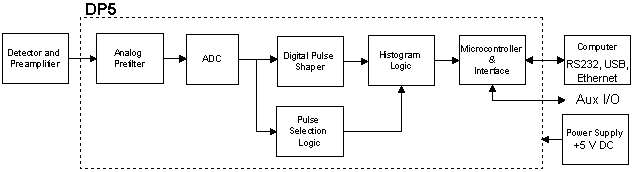

    Figure 3. Block diagram of the DP5 in a complete system.

    Analog Prefilter

    The input to the DP5 is the output of a charge sensitive preamplifier. The analog prefilter circuit prepares this signal for accurate digitization. The main functions of this circuit are (1) applying appropriate gain and offset to utilize the dynamic range of the ADC, and (2) carrying out some filtering and pulse shaping functions to optimize the digitization.
    NOTE: The DP5 can be ordered with a charge sensitive preamplifier on the board for use with PMTs.

    ADC

    The ADC digitizes the output of the analog prefilter at a 20 or 80 MHz rate (software selectable). The digitized values are sent, in real time, into the digital pulse shaper. 12 bit ADC is used.

    Digital Pulse Shaper

    The ADC output is processed continuously using a pipeline architecture to generate a real time shaped pulse. This carries out pulse shaping as in any other shaping amplifier. The shaped pulse is a purely digital entity. Its output can be routed to a DAC, for diagnostic purposes, but this is not necessary.

    There are two parallel signal processing paths inside the DPP, the “fast” and “slow” channels, optimized to obtain different data about the incoming pulse train. The “slow” channel, which has a long shaping time constant, is optimized to obtain accurate pulse heights. The peak value for each pulse in the slow channel, a single digital quantity, is the primary output of the pulse shaper. The “fast” channel is optimized to obtain timing information: detecting pulses which overlap in the slow channel, measuring the incoming count rate, measuring pulse risetimes, etc.

    The DP5 uses trapezoidal pulse shaping, which offers high energy resolution, reduces ballistic deficit, and provides excellent baseline stability at high count rates.

    Pulse Selection Logic

    The pulse selection logic rejects pulses for which an accurate measurement cannot be made. It includes pile-up rejection, risetime discrimination, logic for an external gating signal, etc. At high count rates, the DP5 has both better pile-up rejection and higher throughput than a traditional, analog shaping amp.

    Histogramming Memory

    The histogram memory operates as in a traditional MCA. When a pulse occurs with a particular peak value, a counter in a corresponding memory location is incremented. The result is a histogram, an array containing, in each cell, the number of events with the corresponding peak value. This is the energy spectrum and is the primary output of the DP5. The unit also includes several counters, counting the total number of selected pulses but also counting input pulses, rejected events, etc. Auxiliary outputs include eight different single channel analyzers, and both a DAC output and a digital output showing pulse shapes from several points in the signal processing chain.

    Interface

    The DP5 includes hardware and software to interface between these various functions and the user’s computer. A primary function of the interface is to transmit the spectrum to the user. The interface also controls data acquisition, by starting and stopping the processing and by clearing the histogram memory. It also controls certain aspects of the analog and digital shaping, for example setting the analog gain or the pulse shaping time.

    The interface includes a microcontroller that impliments RS232, USB, and Ethernet communications.

    Integrated Power and Interface Board

    Amptek’s DP5X Digital Pulse Processor is a component in the complete signal processing chain of a nuclear instrumentation system. It must be used with other components, including (at a minimum) a detector and preamplifier, and computer and software to communicate. The DP5X itself has its own power supplied so only needs a +5 V DC input. When using the DP5X with Amptek detectors, the integrated power supplies for the detector and preamp are all that is needed.

    The integrated power supply provides power to Amptek detectors and preamps using an external +5 VDC source. The USB interface cannot supply enough current to operate the detectors, so an external DC supply is required, which must be between 4.0 and 12 V.

    DP5 with Amptek Detector/Preamp

    Figure 4. DP5 and Amptek detector/preamp.

    DP5 

    Figure 5. DP5

    Figure 6. DP5 back connector view.

  • Software +


    Software

    There are two distinct software packages that are needed for the DP5: embedded software that runs on the microcontroller on the DP5 (firmware), and acquisition and control software that runs on the attached computer.

    Embedded Software

    The embedded software is responsible for controlling the pulse processing, controlling the MCA, carrying out some data processing, and interfacing with the personal computer. This software is fixed and cannot be modified by the user. Firmware updates will be released by Amptek and can be uploaded in the field by the user.

    Interface Software

    DPPMCA Software

    The DP5 can be controlled by the Amptek DPPMCA display and acquisition software. This software can be used for control and display of the DP5 and supports regions of interest (ROI), calibrations, peak searching, and so on.

    DPP SDK

    The DP5 comes with a complete Software Development Kit (SDK). The user can use this platform to easily develop software to control the DP5 for custom applications or to interface it to a larger system. Examples are provided in VB, VC++, etc.

    Click here to download DP5 software

    Figure 7. DPPMCA display and acquisition software.

  • Applications +


    The A250 Connected to a DP5 Digital Pulse Processor and MCA


    Figure 8. The A250 charge sensitive preamplifier connected to the DP5 or PX5 digital pulse processor and MCA.


    The DP5 Connected to a Germanium (HPGe) Detector


    Figure 9. DP5 digital pulse processor connected to a Germanium (HPGe) detector. Various materials.


    Figure 10. DP5 digital pulse processor connected to a Germanium (HPGe) detector. Various radioisotopes.

    Application Note AN-DPP-003: Using the DP5 with Germanium (HPGe) Detectors


    DP5G for use with Scintillators and Photomultiplier Tubes

    The Amptek DP5G is a state-of-the-art, high performance, low power digital pulse processor designed for use in scintillation spectroscopy systems. Connected to the anode of a PMT, it includes a charge sensitive preamplifier and a digital pulse processor, which replaces both the shaping amplifier and the MCA in a traditional nuclear spectroscopy system. The DP5G offers several advantages over traditional systems, including higher performance, enhanced flexibility, small size, and low cost.


    Figure 11. DP5G show in actual size, 2 in X 1.75 in

  • Documentation +