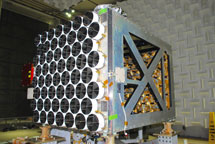
 A view of the NICER X-ray
Timing Instrument without its
protective blanketing. Amptek
SDDs are mounted inside on the
gold colored board.
Credits: NASA/Keith Gendreau
The Neutron star Interior Composition Explorer (NICER) is an International Space Station (ISS)
payload devoted to the study of neutron stars through soft X-ray timing. NICER was launched aboard a SpaceX Falcon 9 rocket on June 3, 2017, installed on the ISS and has begun initial calibration and hardware commissioning. The heart of the instrument is an aligned collection of 56 Amptek silicon drift detectors (SDD) with C Series Windows and X-ray “concentrator” optics (XRC) pairs. Each XRC collects X-rays over a large geometric area from a roughly 30 arcmin2 region of the sky and focuses them onto a small SDD. The Amptek SDD detects individual photons, recording their energies with good (few percent) spectral resolution and their detection times to an unprecedented 100 nanoseconds RMS relative to Universal Time. Together, this assemblage provides a high signal-to-noise-ratio photon-counting capability within the 0.2-12 keV X-ray band, perfectly matched to the typical spectra of neutron stars as well as a broad collection of other astrophysical sources.